


How to Choose Silver Mirror Glass
A silver mirror sample can look clear on its own, yet show a different colour beside another panel. In a bulk order, the wrong thickness or a damaged backing can also cause rejects during assembly. Agree on the sample, specifications, and inspection criteria before placing the order.
To choose silver mirror glass, confirm the base glass colour, backing construction, thickness, and sheet size. For finished panels, also specify the edge finish and final dimensions. Check the sample from the front, back, and edges. For bathroom mirrors and large wall mirrors, confirm moisture exposure, mounting compatibility, and how adjacent panels look together.
1. What Is Silver Mirror Glass?
A silver-backed mirror uses glass with a reflective silver film on its rear face. You see the reflection through the glass, so the colour of the base glass affects how the image looks. The layers behind the silver help protect it. When comparing two samples, look at both the reflection and the backing construction.
Leader Glass makes its double-coated silver mirror with a float glass base, a silver film, a copper film, and two or more layers of protective paint. The construction is relevant to importers buying full sheets, furniture manufacturers sourcing cabinet inserts, and contractors specifying wall panels. Tell the supplier which format you need at the start, because sheet dimensions and finished panel dimensions serve different purposes.
2. How Does the Silver Coating Work?
In a traditional silvering process, the manufacturer prepares the rear surface of the glass and deposits a thin layer of silver. This metal layer creates the reflection. A copper film and protective paint can cover the silver. Other products may use different backing systems, so check the construction stated for the specific item you are buying.
For purchase orders, terms such as silver mirror, clear mirror, and double-coated mirror describe different aspects of the product. Silver identifies the reflective metal. Clear describes the base glass. Double-coated refers to the protective paint system in the Leader Glass product description. List these features separately if your team needs to match a previous order or compare samples from several suppliers.
3. Which Silver Mirror Thicknesses and Sheet Sizes Are Available?
Leader Glass lists thickness options that include 1.8, 2, 3, 4, 5, and 6 mm. Listed silver mirror sheet sizes include 1220 × 1830 mm, 1524 × 2134 mm, 1600 × 2200 mm, 1830 × 2440 mm, 2134 × 3300 mm, and 2250 × 3300 mm. Confirm availability for your exact combination of thickness, sheet size, base glass colour, and back-paint colour before ordering.
| What you are buying | What to specify | Why it matters |
| Full sheets for distribution | Sheet dimensions, thickness, colour, and quantity per item | Helps the warehouse identify and separate stock |
| Full sheets for local fabrication | Sheet format and the dimensions of the pieces you plan to cut | Helps you estimate finished pieces per sheet |
| Panels for furniture assembly | Finished dimensions, thickness, and exposed edge finish | Helps the panels fit the frame and retaining system |
| Panels for a wall or vanity | Finished dimensions, joint layout, and mounting requirements | Helps the installer check fit and alignment |
For sheet orders, test the format against your actual cutting list. For example, a buyer producing several cabinet widths should compare how many usable pieces each format yields after edge trimming. For finished panels, check thickness against the frame or mounting system, especially when replacing one item in a range that uses the same hardware across several sizes.

4. How Do You Specify Glass Colour and Back-Paint Colour?
Base glass colour affects the reflection viewed from the front. Back-paint colour identifies the protective finish on the rear. A buyer who asks for a “grey mirror” could mean a Euro grey glass substrate or a clear substrate with grey back paint. Write both selections explicitly so the sample and quotation refer to the same construction.
| Intended result | How to write the request |
| Clear reflection with grey paint on the rear | Clear substrate with grey back paint |
| Grey tone in the reflected image | Euro grey substrate with the required back-paint colour stated separately |
| More neutral appearance with less green tint from the base glass | Ultra-clear substrate, subject to sample approval |
The listed substrates include clear, ultra-clear, bronze, Euro grey, and shades of blue and green. Back-paint options include grey, blue, green, and white. Confirm the specific combination before approving a sample. If the mirror will sit beside white cabinetry, pale tile, or another panel from an earlier batch, review the sample against that material under the intended lighting.
5. What Changes for Bathroom Mirrors and Large Wall Mirrors?
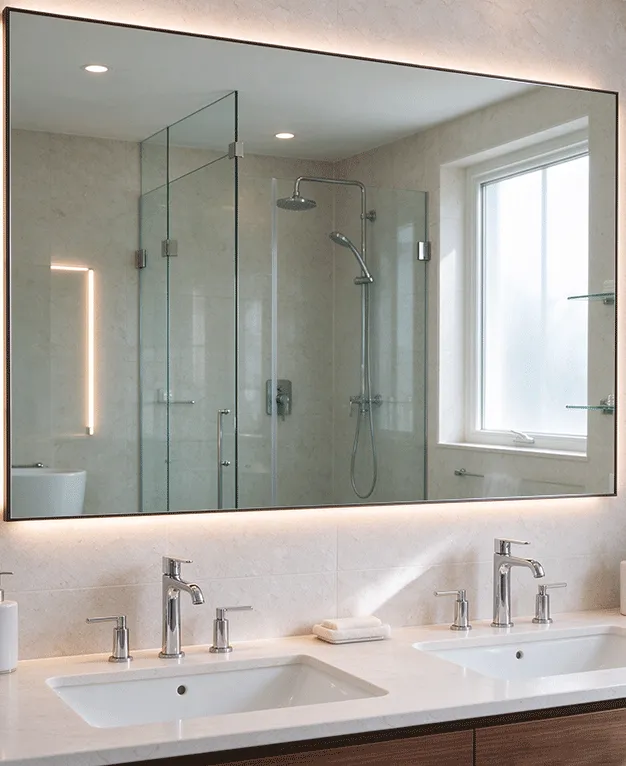
For a bathroom mirror, share where it will sit relative to the basin, splashback, lighting, and fittings. Note whether the finished edges will remain exposed and how the space will be cleaned. The mounting design should allow suitable ventilation and keep water from collecting at the lower edge. Confirm that any proposed adhesive is compatible with the backing.
For a large wall mirror or a row of adjacent panels, review appearance across the layout. Use a mock-up where colour matching, alignment, or the appearance of a long reflected line matters. A small sample can establish the colour reference. A larger mock-up gives the buyer and installer a way to assess the panels at the intended viewing distance, with the proposed joints and lighting.
Consider an illustrative hotel order with two bathroom layouts and a full-length dressing mirror. The buyer can retain one approved colour reference across the project and give each panel its own size, edge finish, and item number. This allows the team to check each piece against the correct drawing at receiving while using one reference for the reflected tone.
6.How Should Buyers Inspect a Silver Mirror Sample?
Use the sample to agree on what the receiving team will check. Inspect the face and reflection under the same light, then turn the piece over and examine the paint. Finally, check the edges and corners. A polished edge on a small sample can show the intended finish, while a full-size first piece can also confirm dimensions, fit, and appearance at normal viewing distance.
| Inspection point | What to check | What to record |
| Reflected image | Clarity, visible distortion, and consistency with the approved appearance | Viewing distance, lighting, and reference sample ID |
| Base glass colour | Colour of the reflection and exposed edge | Clear, ultra-clear, or named tint |
| Back paint | Agreed colour and visible damage such as scratches or exposed areas | Paint colour and acceptance criteria |
| Edges and corners | Chips, darkening, and consistency of any polished or beveled finish | Edge profile and agreed defect limits |
| Size and fit | Thickness, finished dimensions, and fit with the frame or mounting system | Drawing revision and agreed tolerances |
For repeat orders, keep the approved reference alongside the specification. If the supplier needs to quote a different glass or backing combination, ask for a fresh sample before approving the change. This is particularly useful when new panels will be displayed beside older ones, or when your customers expect the same finish from batch to batch.
7. What Causes Black Edges on Silver Mirrors?
Black edge is darkening that can develop when liquid reaches and damages the edge area. Moisture or incompatible chemicals can also affect the backing. During fabrication, inspect exposed edges and protect the painted back from scratches. Before mounting, check adhesive compatibility and the areas where water might collect.
For routine cleaning, apply a compatible glass cleaner to a soft cloth and dry the edges promptly. In bathrooms and hospitality projects, share the care instructions with the maintenance team. If darkening appears on arrival, photograph the affected edge and backing and record the crate and item references so the supplier can review the condition with you.
8. When Should You Compare a Silver Mirror with an Aluminium Mirror?
Compare both when the buyer can choose between silver and aluminium backing and wants to balance reflected appearance with cost. Silver is worth evaluating for vanity and dressing areas where the reflected image matters to the end customer. An aluminium mirror is an option to consider for furniture and decorative applications where the buyer has a tighter material budget.Ask for samples with the same thickness and comparable base glass. Then compare colour, image clarity, and edge appearance side by side. For pricing, give both suppliers the same sheet dimensions or finished panel drawings, required quantities, and packing terms. If you cut locally, compare the cost per usable piece after allowing for cutting, finishing, and offcuts.
9. What Should a Bulk Silver Mirror Inquiry Include?
A useful inquiry gives the supplier enough detail to confirm the proposed glass and prepare a quote. Start with the application, backing construction, thickness, glass colour, back-paint colour, and dimensions. For finished panels, attach the drawing and mark exposed edges. For mixed orders, state the quantity for each size and how you want crates grouped.
We supply mirror sheets and review fabrication requests for overseas importers, distributors, furniture makers, and project buyers. Send your specification and quantities so we can confirm available combinations, review fabrication details, and discuss export packing.
FAQ
Does grey back paint make a mirror look grey from the front?
For a grey reflection, specify a grey glass substrate and approve a viewing sample. Grey back paint describes the finish on the rear. Write both colours on the inquiry when the project specifies them.
Can silver mirror sheets be supplied cut to size?
Send the finished width, height, thickness, edge finish, and quantity. Attach a drawing for shaped pieces or cutouts. The supplier can then confirm fabrication feasibility for the requested combination.
How do I match a replacement panel to an existing wall mirror?
Start with the original part number or specification if available. Match the glass thickness, substrate colour, and edge profile. Compare a sample beside the existing panels under the room lighting before approving the replacement.
Can I order different thicknesses and colours in one shipment?
Submit a list showing each thickness, substrate colour, back-paint colour, sheet size, and quantity. The supplier can confirm which combinations are available and how to group the shipment. Use separate item numbers for pieces that look similar in the crate.
Should I approve a small sample or a full-size first piece?
Use a small sample to approve colour, reflection, and backing appearance. Request a full-size first piece when you also need to check dimensions, edge finish, frame fit, or how the reflection looks at the intended viewing distance.